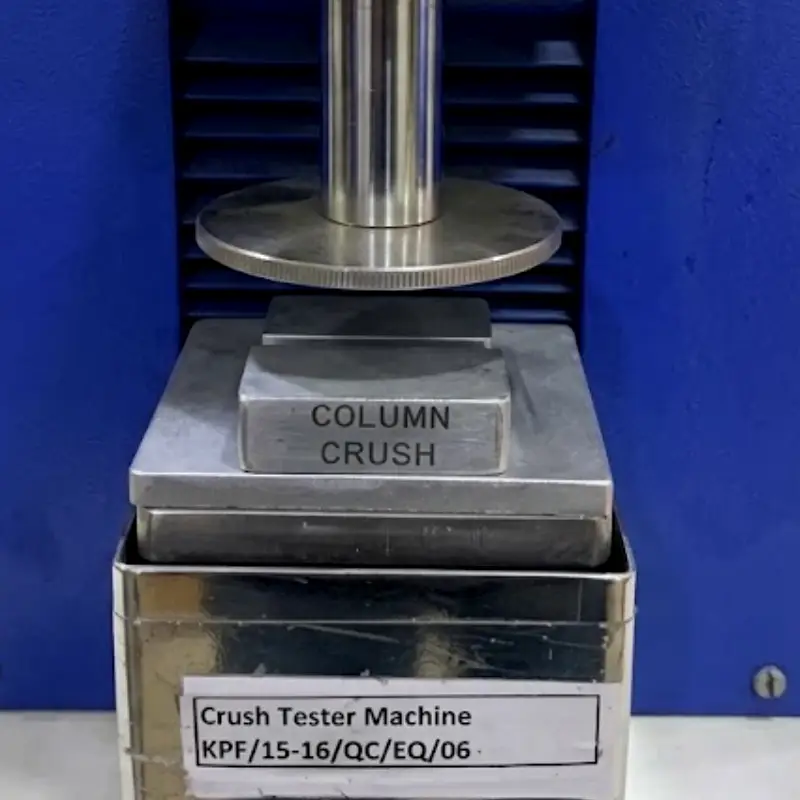
The Edge Crush Test (ECT) measures the stacking strength of corrugated cardboard, indicating how much pressure a box can withstand before collapsing. It is essential for businesses shipping heavy or fragile items, as ECT helps determine the right box type, ensuring safe storage, transport, and protection for products of all sizes.
Calculating ECT involves testing a sample strip of corrugated board by applying a vertical force until it crushes. The results, measured in pounds per inch (lb/in) or kilonewtons per meter (kN/m), guide manufacturers and packagers in choosing single, double, or triple wall boxes suitable for specific shipping and storage requirements.
What is the Edge Crush Test?
The Edge Crush Test (ECT) is a standard method used to measure the stacking strength of corrugated cardboard. It determines how much vertical pressure a box can withstand before collapsing.
ECT is measured in pounds per inch (lb/in) or kilonewtons per meter (kN/m) and helps manufacturers and businesses choose the right single, double, or triple wall corrugated boxes, ensuring reliable protection, stability, and performance during shipping and storage.
What is 32 ECT Corrugated?
32 ECT corrugated refers to cardboard that has been tested to withstand 32 pounds per inch of edgewise compression. This rating indicates the box’s stacking strength and ability to resist crushing when pressure is applied vertically. It is commonly used for shipping lightweight to moderately heavy items in retail and e-commerce applications.
Corrugated boxes with a 32 ECT rating are typically made from single wall corrugated cardboard, offering cost-effective protection for everyday shipments. They are suitable for standard storage, short-distance transport, and products that do not require heavy-duty protection, ensuring adequate strength while keeping packaging lightweight and economical.
How to Calculate ECT of Corrugated Box?

Calculating the Edge Crush Test (ECT) of a corrugated box is essential for determining its stacking strength and suitability for shipping or storage. ECT indicates how much vertical pressure the box can withstand before collapsing, helping businesses select single, double, or triple wall boxes that ensure product protection and reliability.
Tools Needed
- Corrugated box sample
- Digital caliper or micrometer
- ECT testing machine or compression tester
- Ruler or measuring tape
- Notebook for recording results
Step 1: Prepare the Sample
Cut a strip from the corrugated sheet along the edge to be tested. Ensure the strip is clean, flat, and representative of the box’s structure. The width and length should meet testing standards. Proper preparation avoids inaccurate readings and ensures the ECT measurement reflects the true strength of the cardboard.
Inspect the strip for any defects, moisture, or creases that could affect the test. Flatten or trim irregularities to maintain uniformity. Consistent sample preparation is critical because variations can skew results, leading to incorrect conclusions about the box’s stacking capacity and overall performance during shipping or storage.
Step 2: Set Up the Testing Machine
Place the prepared strip in an ECT testing machine, aligning it vertically between the compression plates. Adjust the machine to apply pressure evenly along the strip’s edge. Follow the manufacturer’s guidelines to ensure accurate, repeatable results for single, double, or triple wall corrugated materials.
Calibrate the machine before testing to account for environmental factors like temperature and humidity. Proper setup ensures the applied force is measured precisely, allowing for reliable ECT readings. Accurate calibration helps businesses verify box performance and compliance with industry standards for stacking strength and protection.
Step 3: Conduct the Test
Start the machine to apply vertical force to the corrugated strip until it crushes. Record the maximum force at the point of failure, measured in pounds per inch (lb/in) or kilonewtons per meter (kN/m). Repeat the test on multiple strips to calculate an average ECT value.
Analyzing the results helps determine whether the box meets required strength specifications. The average ECT provides insight into the box’s ability to handle stacking, shipping, and storage demands. Consistent measurements ensure businesses can choose the appropriate corrugated thickness and wall type for optimal protection and durability.
Corrugated ECT Calculator
Understanding the edge crush test (ECT) is essential for determining the strength of corrugated cardboard. Using a corrugated ECT calculator helps manufacturers, packagers, and designers quickly evaluate material performance, ensuring packaging durability and load-bearing capacity. This tool simplifies calculations, saving time and improving accuracy.
- measure board thickness
- select flute type
- input paper weights
- calculate ECT value
The corrugated ECT calculator works by analyzing paper grade, flute profile, and board layers to produce an edge crush test value. Users can adjust input parameters to simulate real-world packaging conditions. This ensures that boxes meet safety and performance requirements for shipping, stacking, and storage.
Box Compression Test vs Edge Crush Test
Understanding the difference between box compression test (BCT) and edge crush test (ECT) is key for assessing packaging strength. While both evaluate cardboard performance, each focuses on different stress points. BCT measures the overall stacking strength of a finished box, whereas ECT measures the strength of the board itself along its edges.
Purpose
Box Compression Test evaluates how much load a fully assembled corrugated box can withstand before collapsing. It reflects real-world stacking and shipping conditions. Edge Crush Test measures the resistance of a single sheet or board edge to crushing forces, predicting the material’s potential stacking performance.
Testing Method
BCT involves placing a filled or empty box in a compression testing machine and gradually applying force until it fails. ECT requires clamping a small sample of board vertically and applying pressure to the edges until it buckles. Each method targets a specific structural weakness.
Materials Evaluated
BCT assesses the complete box, including flaps, folds, and adhesive strength. ECT evaluates the corrugated board alone, considering flute type, paper grade, and thickness. BCT reflects assembled box performance, while ECT focuses on raw material quality.
Results
BCT provides the maximum load a box can safely carry, usually in pounds or kilograms. ECT gives the edge crush resistance in kN/m or pounds per inch. BCT results are practical for logistics planning, whereas ECT predicts potential box strength.
Applications
BCT is used by packagers and shippers to ensure boxes survive stacking during storage and transport. ECT is used by manufacturers to select board grades and design corrugated packaging that meets required strength standards before production.
| Aspect | Box Compression Test (BCT) | Edge Crush Test (ECT) |
|---|---|---|
| Purpose | Measures overall box strength | Measures board edge strength |
| Method | Compressive load on full box | Compressive load on board edge |
| Materials | Full assembled box | Corrugated board only |
| Result | Max load before box failure | Edge crush resistance value |
| Applications | Shipping and storage | Board selection and design |
Conclusion
Understanding the Edge Crush Test helps businesses evaluate the strength and reliability of corrugated boxes. By knowing a box’s ECT rating, companies can prevent product damage, optimize stacking, and reduce shipping losses. Proper ECT knowledge ensures that packaging meets industry standards while maintaining cost efficiency and product safety.
Calculating ECT allows manufacturers to select the right corrugated material for various applications. High ECT values indicate stronger boxes suitable for heavy, fragile, or long-distance shipments, while lower values suit lighter products. Using ECT data ensures boxes perform as expected under pressure, improving operational efficiency and customer satisfaction.
For businesses seeking dependable packaging solutions, get wholesale corrugated boxes from our Letai Packaging. We provide boxes with verified ECT ratings in various sizes and strengths, ensuring product protection, stackability, and durability. Partnering with Letai Packaging guarantees reliable, cost-effective solutions tailored for e-commerce, industrial, and shipping needs.

I have honed my expertise in creating high-quality packaging solutions, bringing both innovation and efficiency to the field. I am passionate about delivering exceptional results and contributing to sustainable packaging practices.
- What is a CBD Box? The Ultimate Guide - June 9, 2026
- Bangle Box Ideas: Inspiring Designs for a Clutter-Free Space - June 8, 2026
- What is a Bangle Box? The Ultimate Guide - June 8, 2026
 English
 Español
 Deutsch
 Français
 Italiano
 日本語
 한국어
 Русский
 Português do Brasil
 العربية