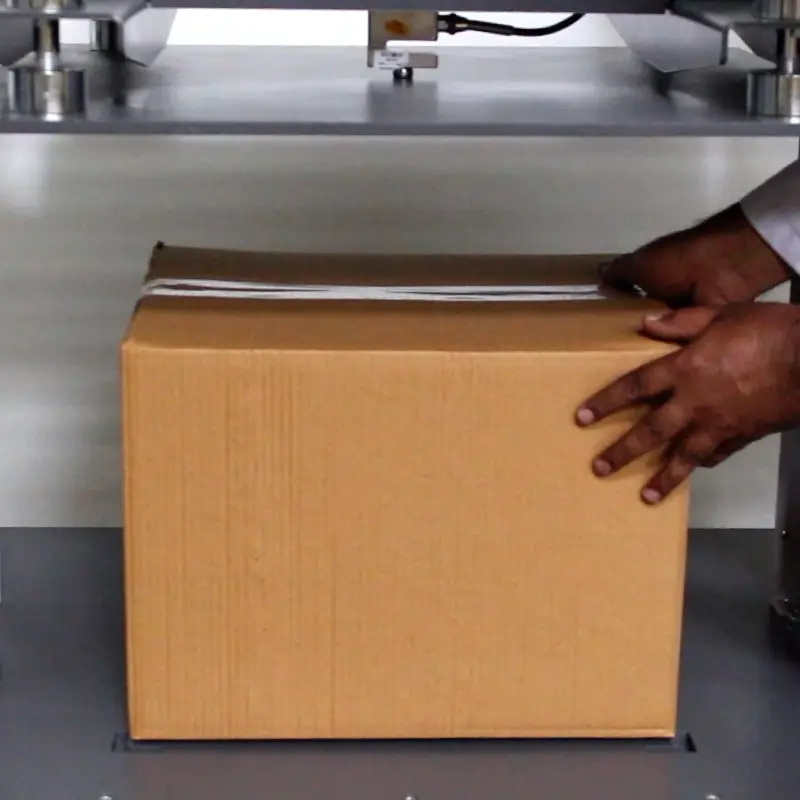
The box compression test plays a crucial role in determining the strength of corrugated boxes. By measuring how much pressure a box can withstand before collapsing, this test ensures that products are safely transported and stored. It helps businesses select the right materials and design for their packaging needs.
Understanding box compression results allows manufacturers and shippers to predict a box’s real-world performance. Factors such as board grade, flute type, and box design directly influence compression strength. By analyzing these aspects, companies can reduce damages, optimize packaging costs, and enhance overall supply chain efficiency.
What is Box Compression Test?
The box compression test (BCT) is a standard method used to measure the stacking strength of a corrugated box. It determines how much vertical pressure a box can withstand before it collapses, simulating real-world conditions during shipping and storage.
By testing board grade, flute type, and box construction, BCT helps manufacturers and shippers ensure that packaging is strong enough to protect products, reduce damages, and optimize material usage.
Why is Box Compression Test Important?

The box compression test is essential for evaluating the strength and reliability of corrugated boxes. It helps businesses ensure products are protected during shipping and storage while guiding material selection and box design for cost-effective, durable packaging solutions.
- Protects Products During Shipping: Corrugated boxes face pressure during transit, stacking, and storage. Testing compression strength ensures boxes won’t collapse under these conditions, reducing product damage, returns, and losses. This provides confidence in safe delivery and maintains customer satisfaction throughout the supply chain.
- Optimizes Material Use: BCT results help manufacturers select the ideal board grade and flute combination. Using optimal materials prevents overuse and reduces packaging costs while maintaining sufficient strength, ensuring a balance between durability and cost-effectiveness for both manufacturers and end-users.
- Improves Supply Chain Efficiency: Strong, tested boxes reduce failures in warehouses and during transport. This minimizes delays, product damage, and replacement shipments. Reliable packaging improves operational efficiency, ensuring goods reach customers safely and on time, which strengthens overall supply chain performance.
- Supports Compliance with Standards: Industries often require boxes to meet specific strength criteria. Box compression testing ensures compliance with quality regulations and certifications, helping businesses maintain brand reputation, avoid legal issues, and provide clients with packaging that meets industry standards.
- Guides Packaging Design Decisions: BCT results allow engineers to refine box dimensions, flutes, and material choices. Testing informs design decisions that maximize strength while controlling costs, resulting in boxes that perform reliably under stacking and shipping conditions.
How to Conduct Box Compression Test?
The box compression test is a crucial assessment for packaging materials. Conducting the test involves placing a box specimen between two parallel plates. Gradually, pressure is applied until the box fails.
This method simulates real-world stacking conditions during storage and transportation. Accurate testing ensures packaging reliability and product protection.
Tools Needed:
- Compression testing machine
- Corrugated box samples
- Measuring tape
- Gloves and safety gear
Step 1: Prepare the Box Specimen
The first step is to prepare the box specimen. Inspect the box for any damage and ensure it is properly assembled. Measure its dimensions and record them accurately. Proper preparation guarantees that results reflect the actual strength of the box, avoiding misleading data during testing.
Step 2: Set Up the Testing Machine
Position the box between the two parallel plates of the compression testing machine. Adjust the plates so that they align evenly with the top and bottom surfaces of the box. This alignment ensures uniform pressure application and prevents skewed results caused by uneven force distribution.
Step 3: Apply Pressure Gradually
Start the machine to apply pressure at a consistent rate. Gradually increase the load on the box until it collapses or reaches the defined failure point. Monitor the process closely to capture the exact point of failure. This step simulates real-world stacking conditions and tests box durability.
Step 4: Record and Analyze Results
After the box fails, record the maximum compression force it withstood. Analyze the results to determine if the box meets strength requirements. Compare findings against industry standards such as ECT values. Proper analysis helps guide packaging improvements and ensures products are protected during shipping.
Step 5: Consider Environmental Factors
Environmental conditions like humidity and temperature can influence box strength. Perform tests under controlled conditions or simulate the expected environment. Adjusting for these factors ensures test results reflect real-world performance and supports better packaging design for varying transit conditions.
BCT vs ECT

Box compression test (BCT) and edge crush test (ECT) are two critical methods for evaluating corrugated box strength. BCT measures the overall stacking strength of a box, while ECT measures the edge strength of the board itself. Understanding the differences helps businesses choose suitable packaging for protection, cost-efficiency, and shipping requirements.
BCT Overview
BCT assesses how much vertical pressure a complete corrugated box can withstand before collapsing. This test simulates real-world stacking conditions during storage and transportation. It accounts for the box’s overall structure, including flutes, walls, and seams, providing a comprehensive view of packaging durability and product protection.
ECT Overview
ECT measures the edge strength of a single piece of corrugated board. It indicates how well the material resists crushing when pressure is applied to its edge. ECT is useful for predicting box stacking strength and helps in selecting the appropriate board grade for cost-effective packaging design.
Material Focus
BCT evaluates the assembled box as a whole, including folds, flaps, and adhesives. ECT focuses only on the board material, ignoring the full box construction. This distinction helps manufacturers understand whether weaknesses are due to material quality or box design.
Application in Packaging
BCT is applied when knowing the maximum stacking weight and storage conditions is essential. ECT is often used in production to quickly assess board strength before box assembly. Combining both tests ensures packaging is strong, efficient, and meets shipping standards.
Cost and Efficiency
ECT is faster and less expensive than BCT, making it ideal for routine material checks. BCT provides more accurate predictions for real-world performance but requires more time and equipment. Balancing these tests helps businesses manage costs while ensuring adequate protection.
Here is the chart showing you the differences BCT and ECT:
| Aspect | BCT (Box Compression Test) | ECT (Edge Crush Test) |
|---|---|---|
| Measures | Whole box strength | Board edge strength |
| Purpose | Stacking and shipping simulation | Predicting material performance |
| Test Focus | Complete box construction | Corrugated board only |
| Time & Cost | Longer, more expensive | Quick, cost-effective |
| Usage | Final product assessment | Material selection and QC |
Conclusion
Conducting a box compression test is essential for assessing corrugated box durability and ensuring product protection. Accurate testing helps manufacturers select the right box specifications, prevent shipping damage, and maintain customer satisfaction. Businesses that rely on shipping must prioritize compression strength for efficient packaging solutions.
By evaluating the compression strength, companies can make informed decisions on board type, box design, and stacking methods. This leads to cost savings, fewer returns, and improved product safety. Regular testing also supports compliance with industry standards, giving businesses a competitive edge in quality packaging.
For reliable and cost-effective packaging solutions, get wholesale corrugated box packaging from our Letai Packaging. We offer a wide selection of durable boxes that meet compression strength standards, ensuring your products reach customers safely while optimizing your packaging efficiency.

I have honed my expertise in creating high-quality packaging solutions, bringing both innovation and efficiency to the field. I am passionate about delivering exceptional results and contributing to sustainable packaging practices.
- What is a CBD Box? The Ultimate Guide - June 9, 2026
- Bangle Box Ideas: Inspiring Designs for a Clutter-Free Space - June 8, 2026
- What is a Bangle Box? The Ultimate Guide - June 8, 2026
 English
  Español
  Deutsch
  Français
  Italiano
  日本語
日本語  한국어
한국어  Русский
  Português do Brasil
  العربية