Look at a professionally printed magazine. The sharp text and vibrant colors are no accident. They are the product of a specific, powerful technology.
This leads to a fundamental question for any business or creator: What is the offset printing? It is the time-tested process that has been the gold standard for quality mass production for over a century.In an age of instant digital alternatives, why does this traditional method still dominate?
The answer comes down to quality, cost, and scale. Understanding the difference is crucial for making the right choice for your project. The offset printing press market projected to reach USD 11.8 billion by 2032.
This article will break it all down. We will explain how offset printing works, compare it to digital printing, and show you what it’s used for. You will also learn its key advantages and disadvantages. By the end, you’ll know exactly when to choose offset printing for your needs.
What is the Offset Printing?

Offset printing is a commercial printing technique where an inked image is transferred, or “offset,” from a metal plate to a rubber blanket before being pressed onto paper, rather than printing directly.
This indirect method is the standard for high-volume jobs because it delivers exceptional quality, producing sharp and consistent images ideal for books, magazines, and marketing materials.
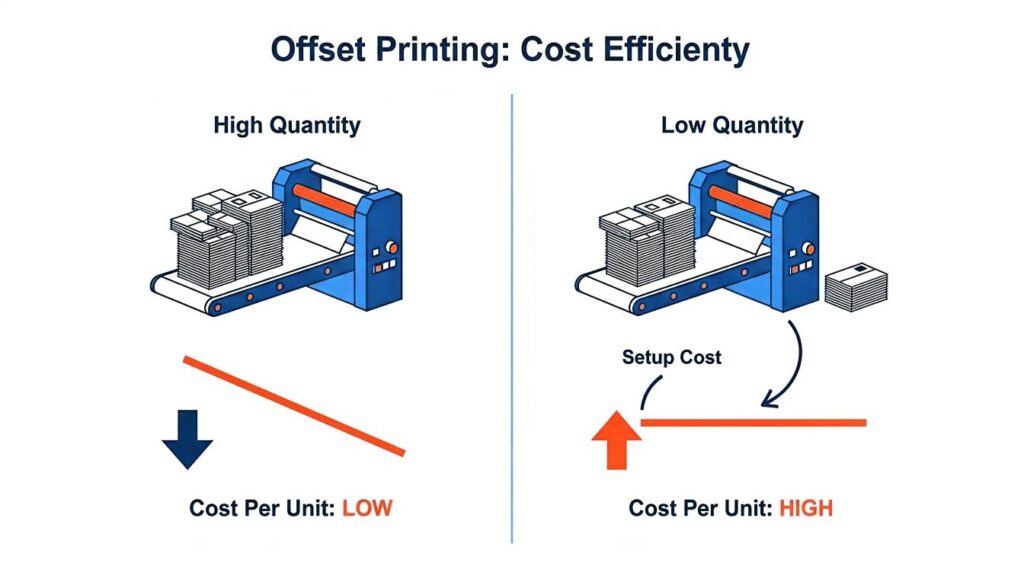
While its initial setup costs are higher, the price per piece becomes very low on large print runs, making it highly cost-effective at scale.
Offset vs. Digital Printing: A Comparison
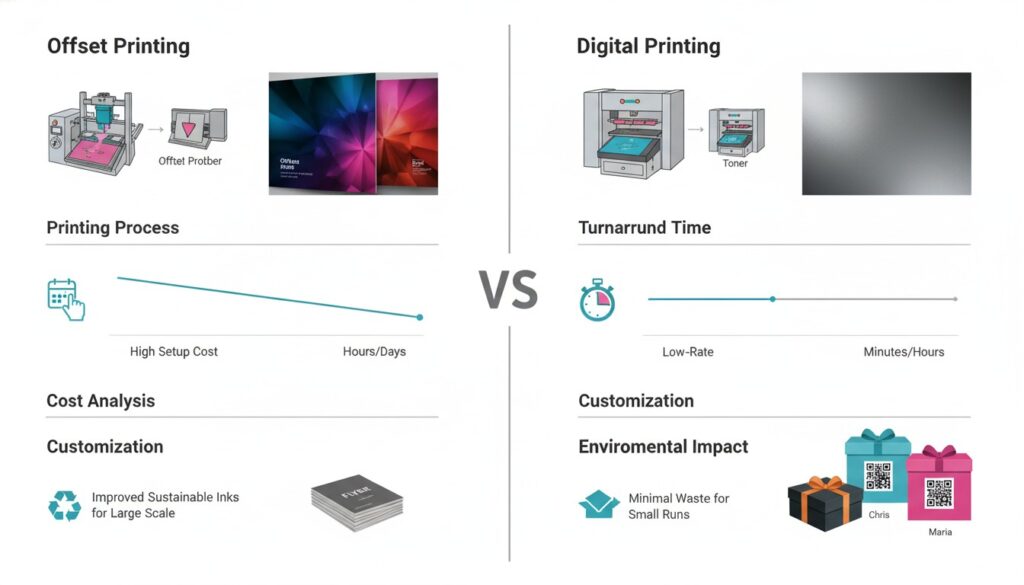
Offset and digital printing are two different tools. Choosing the right one is crucial for your project.
Offset is the traditional choice for large volumes where quality is paramount. Digital printing offers speed and flexibility for smaller, custom jobs.
You can check the ultimate difference via our Offset vs. Digital Printing article, for the main differences between the two include the following:
Printing Process
The core difference is how they apply ink.
Offset printing is indirect. It uses a metal plate to put ink on a rubber blanket. That blanket then rolls the image onto the paper. Digital printing is direct. It takes a file and prints ink straight onto the paper, with no plates involved.
Quality
Offset printing delivers the highest quality. The process allows ink to absorb deeply into the paper, creating rich, accurate colors and sharp lines.
Digital printing quality is excellent for most needs. However, it can sometimes struggle to match the absolute perfection of offset. Colors might be slightly less vibrant.
Cost
Your project’s size determines the cost.
Offset has high setup fees. But the price per piece drops as you print more. It’s best for big jobs. Digital has almost no setup cost. It is perfect for small orders.
Turnaround Time
Digital printing is fast.
With no plates to make, prints can be ready in minutes. It is the best choice for tight deadlines. Offset printing takes more time due to plate creation and press setup.
Customization
Digital printing offers easy customization. You can print a different name on every invitation. This is called variable data printing.
Offset cannot do this. Every copy is the same.
Environmental Impact
Both methods are becoming more eco-friendly. Digital printing creates less waste on small jobs because you only print what you need. The offset industry is also improving, using better inks and reducing chemical use to remain a sustainable choice for large-scale production.
| Feature | Offset Printing | Digital Printing |
| Printing Process | Indirect process using plates and blankets. | Direct process from a digital file. |
| Quality | Highest possible quality, rich and accurate colors. | Excellent quality, very close to offset. |
| Cost | High setup cost, but cheaper for large volumes. | No setup cost, cheaper for small volumes. |
| Turnaround Time | Slower (days). | Much faster (minutes to hours). |
| Customization | Not possible; all prints are identical. | Easy; every print can be unique. |
| Environmental Impact | More setup waste; becoming greener. | Less waste for small jobs; print-on-demand. |
In summary, neither printing method is universally superior. The right choice is determined by your project’s unique requirements for quality, speed, and volume.
For a deeper dive into the capabilities of digital printing, you can explore our detailed guide. To continue learning about the traditional method, let’s now examine the specific stages of offset lithography. For more printing techniques, click here.
How Offset Printing Works
Offset printing is a step-by-step process. Each stage depends on the one before it. An early mistake is hard to fix.
Consider a design file without a bleed. The final product will have white edges after cutting. To prevent this, every stage follows a strict order. This ensures the final quality of the product.
Pre-press Preparation (The Foundational Quality Control Stage)
Pre-press is the first phase. It prevents problems later on. The goal is to match files, materials, and machines. Mismatches lead to waste.
- Design File Processing & Review
Use vector files. Formats like AI or CDR are best. Raster images can look blurry when printed. Colors must be in the CMYK model. Using RGB files will cause color shifts during printing.
A 3mm bleed is required. This is extra artwork around the edges. It prevents white borders after the final trim. All text must be converted to outlines. This action avoids font problems on the production machines. Small text should use simple fonts for clarity. If you have a specific brand color, provide the Pantone code. We use it to match the color exactly.
The file is checked with software. It is then converted to a press-ready format. - Proofing & Confirmation
Next, we make a proof. It can be a digital file or a physical sample. The proof confirms three things: color, content, and size. This is the final check before the full production run begins.
The proof is a color guide. The final product may have slight color variations. This is a normal result of using different batches of ink and paper. - Material Preparation & Inspection
We prepare the materials. The paper is checked for correct thickness and smoothness. The inks are prepared. This includes standard colors and any custom colors. Finally, we create the printing plates from the design file. Each plate is inspected for scratches or other flaws. - Equipment Calibration
The printing press is calibrated. All key parts are cleaned and checked. A clean machine is necessary for a clean print.

Ready To get Custom Packaging ?
Contact us with a Lower Quantity
On-press Operations (Process Control and Waste Management)
This is the core production phase. We monitor it in real-time. This prevents batch-wide errors like color shifts or bad alignment.
- Makeready & Test Printing
First, we mount the plates on the press. They are carefully aligned. Then, we load the paper. The machine’s speed is set for the paper’s thickness.
Next comes the ink-and-water balance. This step is critical. Too much ink causes smears. Too little ink looks faded. We print test sheets. We check them against the approved proof for color and alignment. When the output is correct, a “first-off sample” is approved. This sample becomes the quality standard for the whole job. - Full Production Run
The main run begins. Operators pull sheets from the press to inspect them. They check for color consistency and accurate registration. They also watch for paper wrinkles. The environment can affect the paper, so machine settings may be adjusted. Waste is kept to a minimum. If too many sheets are spoiled, the press is stopped to find the cause. - Post-print Stacking
Printed sheets are stacked. Special paper is often placed between the layers. This prevents wet ink from smudging. Sheets with heavy ink coverage need more time to dry.
Post-press Finishing (Converting Flat Sheets into a Final Product)
Offset printing makes flat sheets. Post-press turns them into a final product. This stage requires precision.
- Surface Treatment
Finishes can be applied. They protect the print and add texture. Common options include lamination, spot UV, and foil stamping. Lamination adds a protective film. Spot UV adds gloss to certain areas. Foil stamping applies a metallic finish for a premium look. Each process has its own rules. Ink must be dry for lamination. Foil needs the right temperature and pressure. We control these details to prevent defects. - Die-cutting & Creasing
The product is now shaped. A custom “die” cuts the package shape from the flat sheet. Alignment must be perfect. A crooked cut means the box will not assemble correctly. We also crease the fold lines. The crease depth is set for the paper’s thickness. This ensures a clean fold. - Folding & Assembly
This is the final step. The flat sheets are folded into their final shape. This can be done by hand or by machine. We check that all joints and locks work as they should.
A final quality check is performed on a sample of the products. They are inspected for scratches, smudges, and the correct size. Defective items are removed.
What are the Advantages and Disadvantages of Offset Printing and When to Choose Offset Printing?
Offset printing is a powerhouse in the packaging world. It functions like a specialized tool. Using it in the right scenario delivers exceptional results, while using it in the wrong one creates problems.
Here are its core strengths and weaknesses.
What are the Advantages of Offset Printing
1. Excellent Cost-Effectiveness for Large Volumes
Offset printing saves money on large orders. It has initial setup costs for plates and machine calibration, but as the print run grows, this fixed cost is spread across thousands of units. The price per piece drops significantly. This makes offset the most economical choice for mass production.
2. Unmatched Brand Color Consistency
Your brand color is a key asset. Offset printing ensures perfect color consistency. It can use pre-mixed Pantone® inks to create a pure, solid color, not a mix of dots. Every package looks identical. This builds brand trust and prevents any customer doubt about authenticity. Especially for luxury perfume boxes, cosmetic boxes, and gift boxes.
3. Seamless Integration with Premium Finishes
Offset provides a perfect surface for premium finishes. Techniques like foil stamping, lamination, and spot UV adhere flawlessly. This elevates your packaging and increases its perceived value(like Essential Oil Packaging, handmade soap box ).
4. Superior Detail and Clarity
Offset excels at printing fine details. Small text stays sharp and legible. Barcodes scan reliably. Gradients are smooth and clean. This precision is essential for both regulatory information and a high-quality aesthetic like wine packaging, candle packaging, and vape packaging.
What are the Disadvantages of Offset Printing
1. Prohibitive Cost for Small Quantities
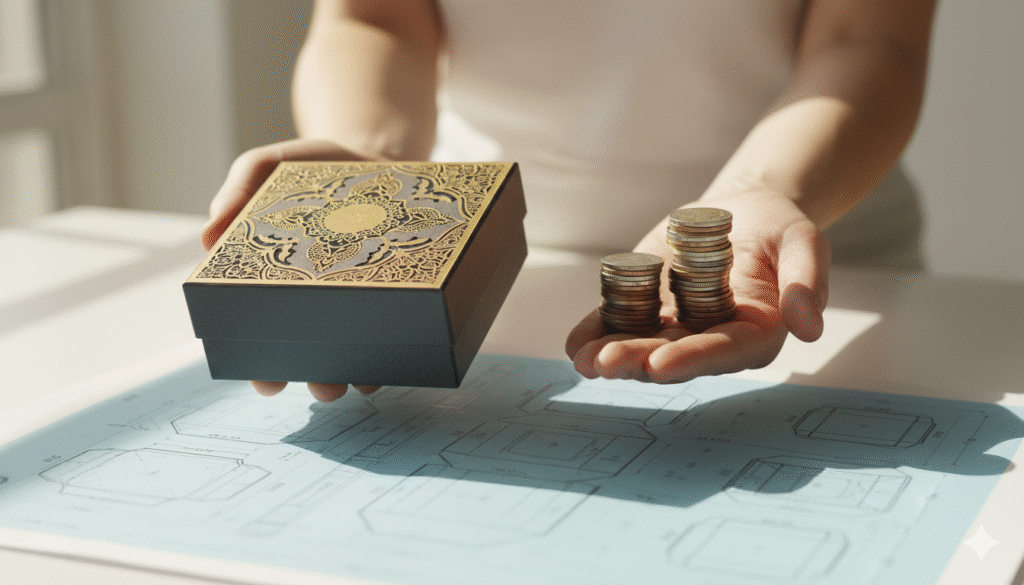
The high setup cost makes offset a poor choice for small jobs. For a few hundred units, the price per piece can be very expensive. It is not suitable for market tests or limited-edition products.
2. Long Turnaround Times and Inflexibility
Offset is not fast. Making plates and setting up the press takes several days. Changes are also difficult and costly once the process starts. This rigidity can lead to missed deadlines for a product launch or marketing campaign.
3. Limited Material Compatibility
Offset printing has material limitations. It works best on flat, smooth surfaces like paper and cardstock. It cannot print directly on plastic, metal, or heavily textured materials.
4. No Support for Personalization
Every print in an offset run is identical. The process uses a fixed plate, which means no personalization is possible. You cannot print unique names, codes, or other variable data. For that, you need digital printing.
Summary: Making the Right Choice
Choosing the right printing method is a critical decision. It is a balance between volume, cost, speed, and customization. Offset printing offers unparalleled quality and cost-efficiency for large-scale projects. However, its requirements for time and volume make it unsuitable for every job.
Understanding these trade-offs is the first step. The next is partnering with an expert who can guide you to the perfect solution for your specific goals.
Navigating these options can be complex, but you don’t have to do it alone. At Letai Printing, we specialize in matching your project’s unique needs with the ideal printing technology. We ensure your packaging is successful, on time, and on budget.
Contact us today to discuss your project and receive a personalized recommendation.

I have honed my expertise in creating high-quality packaging solutions, bringing both innovation and efficiency to the field. I am passionate about delivering exceptional results and contributing to sustainable packaging practices.
- What is a CBD Box? The Ultimate Guide - June 9, 2026
- Bangle Box Ideas: Inspiring Designs for a Clutter-Free Space - June 8, 2026
- What is a Bangle Box? The Ultimate Guide - June 8, 2026
 English
  Español
  Deutsch
  Français
  Italiano
  日本語
日本語  한국어
한국어  Русский
  Português do Brasil
  العربية