Understanding the strength of corrugated boxes is essential for efficient packaging. Two widely used tests, ECT (Edge Crush Test) and BCT (Box Compression Test), measure different aspects of box performance. ECT evaluates the stacking strength of the corrugated board, while BCT determines the overall durability of a finished box under compression.
Choosing the right test helps businesses select the most suitable packaging for shipping and storage. While ECT focuses on the board’s edge strength, BCT assesses the box as a whole, including flaps and construction. Knowing their differences ensures your products remain protected, reduces waste, and improves supply chain efficiency.
What is ECT?
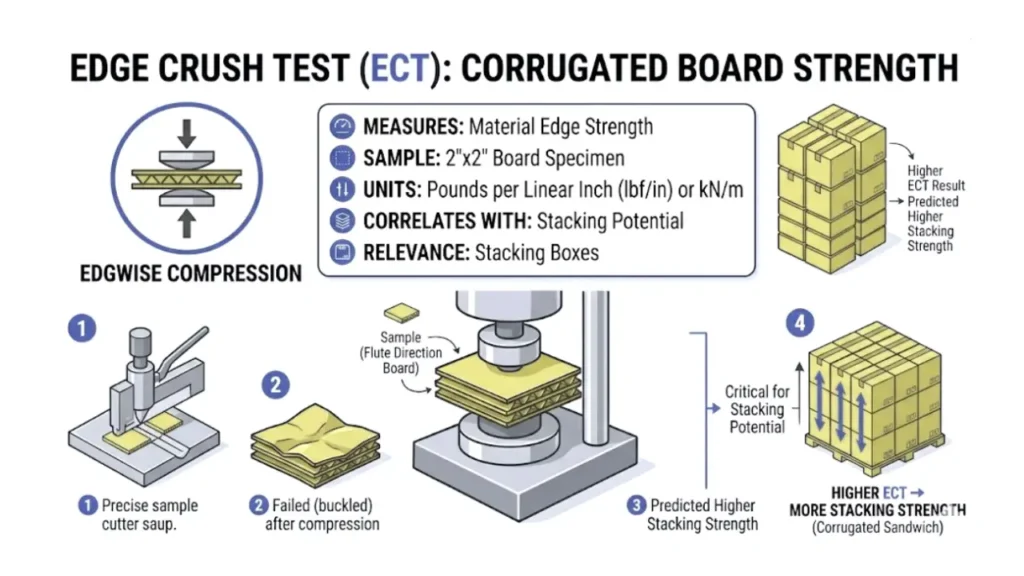
The Edge Crush Test (ECT) measures the stacking strength of corrugated board by testing the force required to crush a small sample’s edge. It helps determine how much weight a box can handle before collapsing, ensuring packaging durability and protecting products during storage and transport.
Benefits of ECT:
- Improved stacking strength: ECT ensures corrugated boards can support heavy loads, preventing damage during storage or transit. Choosing boards with the right ECT rating avoids costly product losses and maintains packaging integrity.
- Cost efficiency: By understanding board strength, companies can optimize material usage, reducing excess cardboard and lowering overall packaging costs while maintaining protection.
- Enhanced shipping safety: ECT-rated boxes are less likely to fail under pressure, keeping products safe during handling, stacking, and shipping, which minimizes returns and customer complaints.
- Sustainability: Using appropriately rated boards reduces waste by preventing damaged products and excess packaging, supporting environmentally responsible operations.
- Quality assurance: Regular ECT testing maintains consistent packaging performance, ensuring your products meet industry standards and customer expectations reliably.
What is BCT?

The Box Compression Test (BCT) measures the maximum weight a fully assembled corrugated box can withstand before collapsing. Unlike ECT, which tests the board itself, BCT evaluates the strength of the finished box under real-world compression conditions, ensuring product safety during stacking, storage, and shipping.
Benefits of BCT:
- Accurate box strength assessment: BCT tests the complete box, including flaps and construction, providing a realistic measure of how it will perform under pressure during transport or storage.
- Product protection: By knowing a box’s compression limit, businesses can prevent damage to goods, reduce returns, and maintain customer satisfaction.
- Optimized packaging design: BCT results help manufacturers design boxes with sufficient strength while avoiding overuse of materials, improving cost efficiency.
- Stacking reliability: BCT ensures boxes can safely withstand stacking in warehouses and shipping containers, reducing the risk of collapse.
- Quality control: Regular BCT testing maintains consistent packaging performance, helping companies meet industry standards and customer expectations with confidence.
ECT vs BCT

ECT and BCT are both essential tests for evaluating corrugated packaging strength, but they measure different aspects. ECT focuses on the edge crush strength of the corrugated board, while BCT tests the overall compression strength of the finished box. Understanding their differences helps businesses choose the right packaging for storage, shipping, and product protection.
Edge Crush Test (ECT)
ECT measures the force required to crush the edge of a corrugated board sample. It indicates how much stacking weight the board can handle, which is crucial for designing packaging that protects products during storage and transport.
ECT focuses on the board itself rather than the finished box. It helps businesses select appropriate material thickness, flute type, and construction, ensuring packaging can withstand stacking pressure without overusing materials.
Box Compression Test (BCT)
BCT evaluates the maximum weight a fully assembled box can endure before collapsing. It measures real-world performance under compression, reflecting the box’s ability to protect contents during shipping, handling, and storage.
BCT considers flaps, folds, and overall box construction. It guides manufacturers in designing boxes that balance strength and material efficiency, preventing product damage and reducing packaging costs while maintaining safety standards.
Here are some differences between ECT and BCT:
| Aspect | ECT | BCT |
|---|---|---|
| Tested Material | Corrugated board | Fully assembled box |
| Purpose | Edge crush resistance | Compression resistance of box |
| Measurement Type | Pounds per inch (lb/in) | Pounds or kilograms (lbs/kg) |
| Focus | Board strength | Box durability |
| Application | Material selection and stacking | Shipping, handling, storage |
How to Choose ECT and BCT?
Selecting the right test depends on your packaging goals and product requirements. ECT is ideal for evaluating the strength of the corrugated board itself, while BCT measures the durability of the finished box under compression.
Understanding your needs ensures the best protection and cost-efficiency for your shipments.
Factors to Consider When Choosing:
- Product weight and size: Heavier or larger items may require boxes tested with BCT to ensure the finished packaging can withstand stacking and transport pressures, preventing damage.
- Shipping and stacking conditions: If boxes will be stacked in warehouses or transported over long distances, BCT provides a more accurate measure of real-world durability, reducing the risk of collapse.
- Material optimization: ECT testing helps select the proper board strength, flute type, and thickness, minimizing material use while maintaining adequate protection and keeping packaging costs low.
- Regulatory or industry standards: Some industries require specific ECT or BCT ratings to meet shipping regulations or quality standards, ensuring your packaging complies with local and international requirements.
- Cost efficiency vs protection needs: Balancing ECT and BCT results allows businesses to choose packaging that provides adequate protection without overusing materials, saving on production costs while safeguarding products.
Conclusion
In summary, ECT and BCT serve complementary roles in packaging quality control. ECT measures the edge strength of corrugated board, providing insight into stacking capability, while BCT evaluates the complete box under compression, reflecting real-world shipping conditions. Both tests are vital for selecting reliable packaging solutions.
By understanding the differences between ECT and BCT, businesses can make informed choices for their packaging needs. Proper testing reduces damage during transport, ensures product safety, and supports cost-effective supply chain management. Choosing the right test ultimately enhances customer satisfaction and operational efficiency.
For wholesale custom corrugated boxes, trust Letai Packaging. We provide durable, high-performing boxes tailored to your product specifications. From small orders to bulk shipments, our solutions ensure your packaging meets industry standards while protecting your goods during storage and transportation. Partner with us for reliable, customizable packaging solutions.

I have honed my expertise in creating high-quality packaging solutions, bringing both innovation and efficiency to the field. I am passionate about delivering exceptional results and contributing to sustainable packaging practices.
- What is a CBD Box? The Ultimate Guide - June 9, 2026
- Bangle Box Ideas: Inspiring Designs for a Clutter-Free Space - June 8, 2026
- What is a Bangle Box? The Ultimate Guide - June 8, 2026
 English
  Español
  Deutsch
  Français
  Italiano
  日本語
日本語  한국어
한국어  Русский
  Português do Brasil
  العربية